


Article Directory
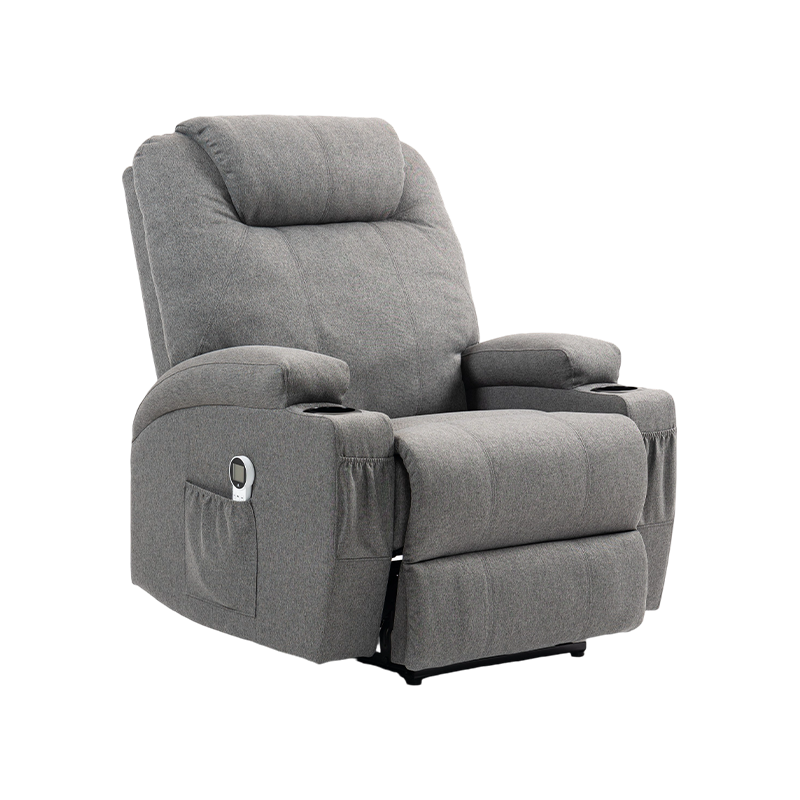
A manual recliner chair delivers on-demand relaxation through a straightforward mechanical system that requires no power outlet, no remote, and no electronics to fail. For living rooms, apartments, and anyone who values simplicity and reliability over automation, the manual mechanism remains the most dependable recliner design on the market — and often the most affordable path to genuine full-body support.
No electricity required — fully mechanical operation
Pounds typical weight capacity for standard home models
Expected mechanism lifespan with normal home use
Average time to reach full recline from seated position
A manual recliner operates through one of three distinct mechanical systems, each activated differently but sharing the same core goal: transferring the occupant's body weight into controlled backward recline while extending the footrest simultaneously.
A steel lever on the side of the chair connects directly to the reclining linkage via a cable or rigid rod. Pulling the handle releases a locking pawl, allowing the backrest to recline in 2–4 fixed positions as the occupant leans back. Releasing the handle locks the chair at the chosen angle. This is the most common manual system, found in over 70% of residential recliner models.
No handle, no lever — the occupant simply applies backward body pressure to the backrest. The spring-loaded linkage compresses progressively, allowing infinite recline angle between upright and full recline. Returning to upright requires a forward lean to decompress the spring. Push-back recliners are generally lower-profile and more apartment-friendly due to their simpler silhouette and slightly smaller footprint.
A modified lever or push-back system mounted on a forward-sliding base track. As the chair reclines, the entire seat base slides 4–6 inches forward, allowing the backrest to recline without requiring clearance space behind the chair. Wall-hugger models need as little as 3–4 inches from the wall — compared to 12–18 inches for standard mechanisms.
Comfort in a manual recliner depends on three layered factors: foam density, lumbar support geometry, and the recline angle range available. High-quality manual recliners use high-resilience (HR) foam rated at 1.8–2.2 lbs per cubic foot in the seat cushion — this density maintains its shape and pressure distribution through 50,000+ compressions, equivalent to roughly 10 years of daily one-hour use.
The backrest angle is the most critical comfort variable. Research in seating ergonomics consistently shows that a 110–130 degree recline angle minimizes lumbar disc pressure compared to upright sitting at 90 degrees — which is why manual recliners with extended recline range (up to 140–160 degrees for near-flat positions) are particularly valued for post-surgery recovery, chronic back pain management, and extended reading or viewing sessions.
Reclining to 135 degrees reduces spinal disc pressure by approximately 54% compared to sitting upright — making a manual recliner one of the most effective passive back-relief tools available for home use without clinical equipment.
Weight capacity in manual recliners is determined by the steel frame gauge, the mechanism steel thickness, and the number of load-bearing contact points in the linkage assembly. Consumer-grade chairs are tested to static load standards that apply a 1.5–2x safety multiplier above the stated rating.
| Capacity Tier | Weight Rating | Frame Construction | Mechanism Grade |
| Standard Home | 220–265 lbs (100–120 kg) | 14-gauge steel frame | Residential |
| Heavy Duty Home | 300–350 lbs (136–159 kg) | 12-gauge reinforced frame | Residential+ |
| Big & Tall | 400–500 lbs (181–227 kg) | 11-gauge welded steel | Semi-commercial |
| Bariatric | 500–700 lbs (227–318 kg) | Dual-reinforced steel chassis | Commercial/Medical |
For users near or above the standard capacity range, always verify the mechanism rating independently from the seat foam rating — some manufacturers state the foam compression limit, not the structural frame limit, which can be misleadingly high.
The mechanical linkage in a manual recliner has no electrical components to degrade, no firmware to update, and no motor brushes to wear out. The primary wear points are the pivot joints, the locking pawl, and the return spring — all of which are repairable or replaceable at low cost compared to electric motor replacement.
Space requirement is the most practical constraint when placing a manual recliner in a smaller home. Standard lever-mechanism recliners require 12–18 inches of clearance behind the chair to reach full recline — a significant demand in compact living rooms. Wall-hugger variants reduce this to 3–5 inches, making them the correct choice for apartments where furniture placement is driven by wall proximity.
Clearance needed behind chair for full recline. Best for rooms where the chair can float away from the wall.
Clearance needed — forward-sliding base compensates. Ideal for apartments and tight living room layouts.
Beyond clearance, apartment-suitable manual recliners typically have a narrower seat width (30–33 inches versus 35–38 for standard), a lower overall height profile, and lighter frame weight — making repositioning or moving between rooms practical without disassembly.
Both are manual — the distinction is in the activation system and the recline experience they deliver. Choosing between the two comes down to control preference, aesthetic priorities, and how the chair will be used most frequently.
| Feature | Lever Manual Recliner | Push-Back Recliner |
| Activation | Side handle or lever | Body pressure on backrest |
| Recline Positions | 2–4 fixed lock positions | Infinite / continuous |
| Footrest | Extends with recline automatically | Usually no integrated footrest |
| Wall Clearance | Standard: 12–18 in / Wall-hugger: 3–5 in | 8–12 in (backrest pivot only) |
| Visual Profile | Traditional recliner silhouette | Resembles standard armchair |
| Ideal For | TV watching, napping, full-body relaxation | Reading, accent seating, modern interiors |
Choose a lever manual recliner if you want a dedicated footrest, a locked recline position for sleeping, or full-body support during extended sessions. Choose a manual recliner chair in push-back configuration if aesthetics and apartment suitability matter more than footrest functionality — push-back models integrate into modern living spaces without announcing themselves as recliners at first glance.

+86-13819261237

+86-572-5082270

sales@ajhqfurniture.com

Factory Building 2, No. 11, Sangang Road, Sunshine District 2, Anji Economic Development Zone, Dipu Street, Anji, Huzhou, Zhejiang, China
Copyright © 2022 Anji Hongqiang Furniture Co., Ltd.Custom Euro Style Convertible Single Functional Recliners Manufacturers



 English
 Español